Sources · Entry 03
Field recording
Going out with a recorder and coming back with time rather than a sound.
Going out with a recorder and coming back with time rather than a sound
The mistake is to go out looking for a particular sound. You go out looking for a duration — thirty minutes at a level crossing, an afternoon in a car park at the edge of town — and you come back with time that can be cut into, reversed, layered, or left almost entirely alone. The recorder is passive. The decision-making starts when you return.
What the equipment catches
A portable digital recorder — an Olympus LS or a Zoom H series are common choices — placed on a surface rather than handheld picks up the room, the ground, the building, and whatever moves through them. Held in the hand it picks up the operator: blood pressure transmitted through a grip, fabric on the casing, the faint muscular tremor of standing still. Neither is wrong. The handheld result is intimate and bodily; the placed result is architectural and patient. The choice is compositional before any software opens.
Microphone capsule type determines the directionality of what is gathered. An omnidirectional capsule accepts everything within a sphere and renders the recordist's position as simply another point in a space. A cardioid capsule rejects sound from behind, which is useful for pulling one element forward but which also falsifies the room by removing half of it. A mid-side configuration, where a cardioid faces forward and a figure-eight faces sideways, can be decoded to any width in post and is the approach most often associated with work that treats tape as an instrument , because the stereo image is malleable after the fact rather than fixed at the moment of capture.
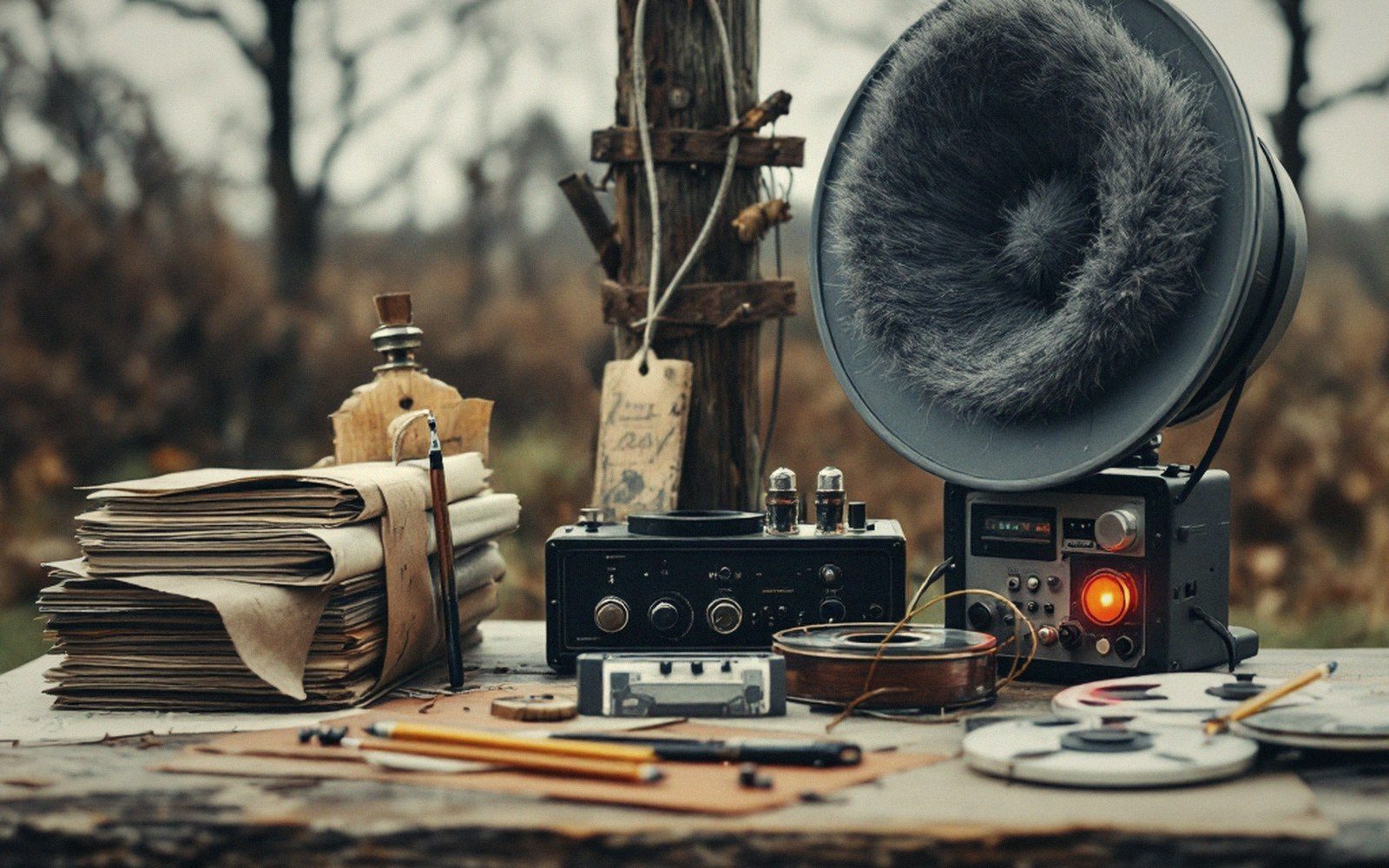
Wind is the primary mechanical problem outdoors. A dead-cat windshield — the colloquial name for a fur-covered foam frame — lowers wind noise but cannot eliminate it when the gusts exceed a certain threshold; the result is not silence but a low, periodic thud that sits just below speech frequencies and is almost impossible to remove cleanly. This is not always undesirable. In a piece where surface and texture are the material, that thud is part of what was there.
What comes back
What you return with is not a sound file. It is a length of recorded time in which things happened at unpredictable intervals: a bird that called twice, a truck that passed and Doppler-shifted, twenty-three minutes of essentially continuous factory hum that turns out to contain tiny variations in pitch nobody noticed at the time. The usable content is discovered in the editing suite, not on location, and it is frequently not what was expected.
This is the structural difference between field recording used as source material and field recording made as a finished document. A finished document — nature recording, journalism, oral history — values the event and its clarity. Source material values the duration and what happens inside it when you listen at low volume for a long time. The same recording serves both purposes, but the listener's posture toward it is opposite.
Placement matters in ways that are not obvious. A recorder left at ground level against a wall in a tiled space captures the full flutter echo of that room; raised to head height, the flutter partly resolves into a broader reverberation. The same location is two different spaces depending on what the capsule is sitting on. Stone floors and wood floors are audibly different materials; the choice is not a recording decision but an architectural one, made once and permanently encoded.
The practice connects to a lineage that runs from the musique concrète experiments at the Groupe de Recherches Musicales in Paris — where Pierre Schaeffer defined the acousmatic condition, sound listened to without knowledge of its source — through the tape-loop and location work of the 1960s and into the prepared and textural practices that follow from them. What distinguishes source-oriented field recording from that tradition is the emphasis on time over event. Schaeffer's objet sonore (sound object) is a discrete unit isolated and repeated. Source-oriented recording resists the isolation: the forty-minute file arrives as a continuous argument, and cutting it is an act of interpretation, not just editing.
Going out is preparation. The piece is what happens to what comes back.